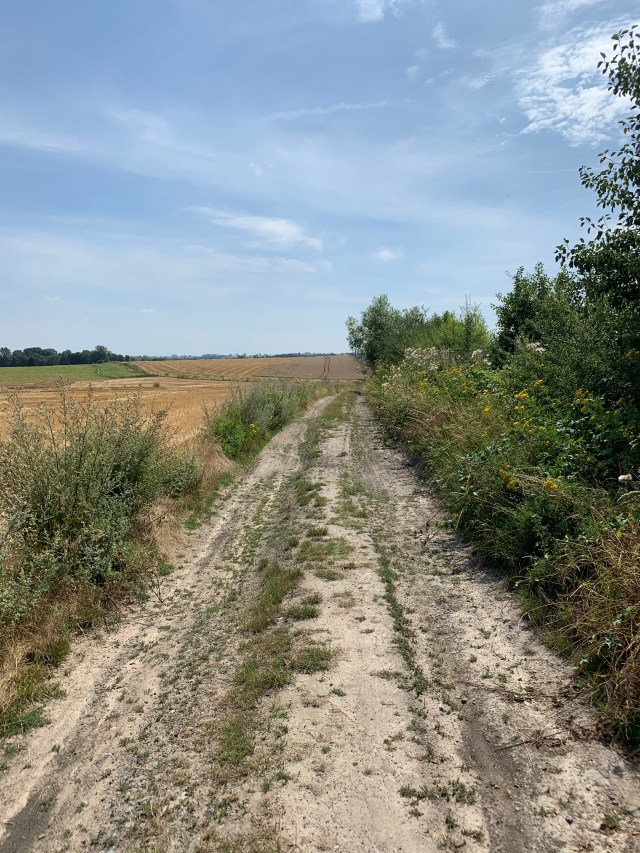
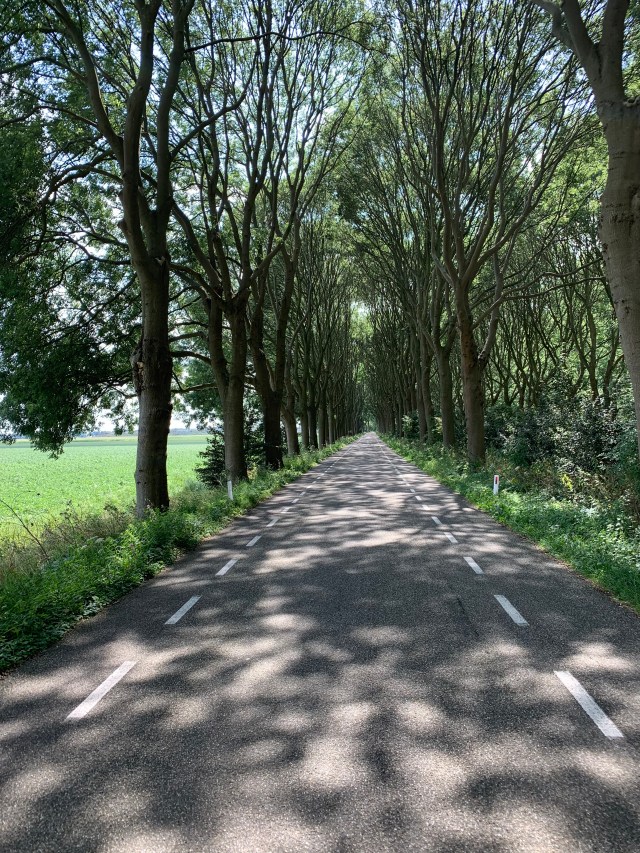
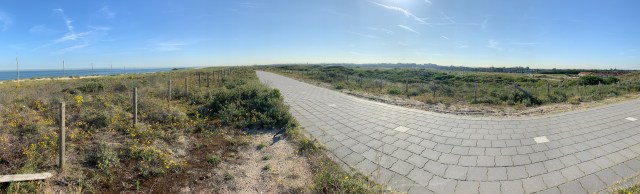
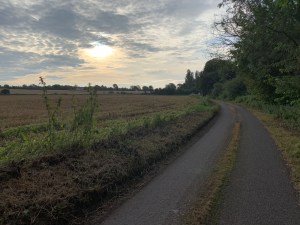
I feel like google maps has a sense of humor sometimes. Not to say that the automated voice which tells me where to go makes joked along the way, although that would be welcome. No she has a much more sophisticated sense of humor. For example, taking me on dirt roads. Now the photo I provided was the very beginning of the road it took me on. By the end it was about half the size and surrounded by prickly bushes. I could sense the laughter coming from my phone as I biked down this path. Now that being said, the google voice was not the only one who smiled a lot during this ride.
On my ride out of the Netherlands and into Antwerp I noticed a shift in the landscape from completely flat to flat with a few mounds scattered here and there. This 100 kilometer ride had actual hills!(Is it odd to say that I missed hills?) Large, imposing, hills that reminded me of home and yet provided me with views I had never imagined before. As I reached the top of the first hill of many hills I exclaimed, out loud, woohoo that’s what we like! I continued saying this phrase every time I reached the top of a significant hill not caring about the strange looks other bikers would give me. This was a very social ride for me. An hour into my ride one biker, biking on the opposite ride of the road as me, waved. A simple hand in the air and a smile that signified a sort of unspoken comradery that only bikers shared. After this interaction I decided that every biker, every backpacker, every person walking their dog or skipping along the road I was going to wave to. It’s these simple acts of kindness, these acts of being social that have the potential of having a profoundly positive effect on someone’s day. Maybe even your own.
Brussels, home of the Belgian Waffle and Belgian fries, capital of Belgium, and one of my all time favorite cities. Walking through Belgium is as though you are walking through a theme park: at every turn there is something new and exciting. The rows of old buildings with golden highlights accentuate a time in which this city was at the height of culture, art, and industry in Europe. While the castles and churches display a grandeur that was only achieved in the Middle Ages. And just when it seems as though you are stuck in the past all of the sudden modern art and new buildings are erected from the ground highlighting the new age that Brussels has been apart of.
Brussels’ physical manifestation of culture only touches upon the character of the city however. Belgium is split up into three separate areas: the Dutch speaking, the French speaking, and the German speaking. Three areas that bring three cultures together into one country and that country is centered in Brussels. Walking through the streets of Brussels you are able to hear dozens of dialects and languages, you are able to see cultural influences from France the Netherlands and Germany it is as if three countries decided to make a city complete with the best qualities from each nation.
Museums/landmarks:
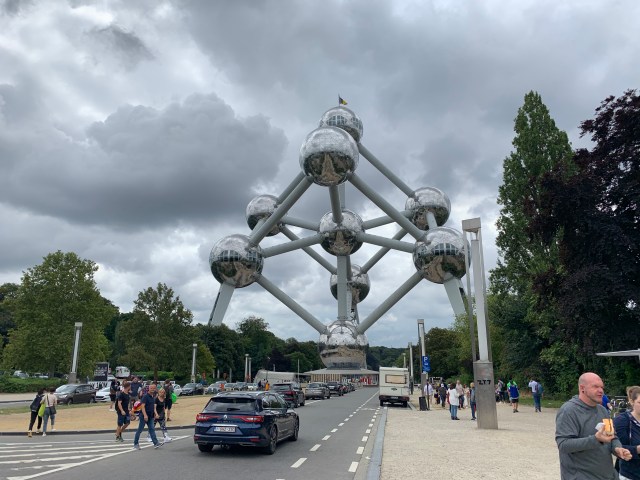
Atomium
This odd structure was built during the 58th Worlds Fair in Brussels (1957). It is a physical representation of an iron crystal, on a molecular level of course, blown up 5 million times. Inside you can enjoy the history behind the construction of the cube as well as a wonderful panoramic view of Brussels.
BElvue Museum
The BELvue museum goes through the history of Brussels and of Belgium. With interactive videos and displays this is not only an extremely informational museum it’s also kind of fun. Furthermore, it connects directly to the Coudenberg ruins so after your visit of a museum that tells you about the history of Brussels you can walk through a bit of it’s history as well.
Botanical Garden of Brussels
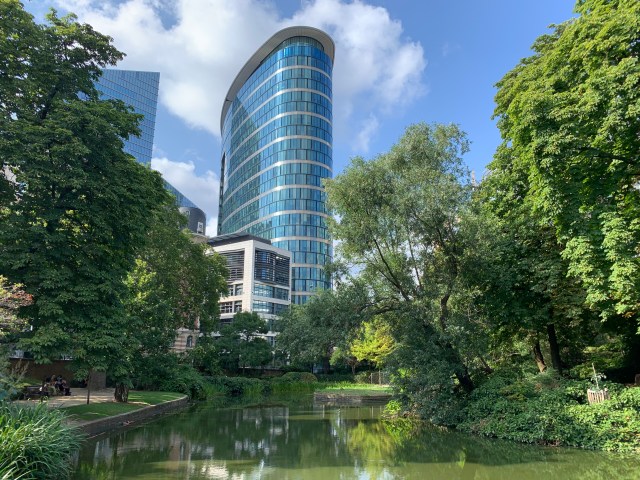
This beautiful park is located on the edge of Brussels center. It houses a variety of different flora and fauna and is honestly a wonderful place to take a nap, read a book, or work on a blog… if your into that sort of thing.
Congress Column
Erected sometime in the mid 19th century, this column is a representation of Belgiums freedom. At the top of the tower is Belgiums first king, King Leopold I, and surrounding the tower are four representations of freedom that are there to commemorate Belgium’s constitution.
Coudenberg
Belgiums former Royal palace, the Coudenberg is now a set of ruins underneath the BELvue museum. Walking through these ruins it’s easy to get lost in the history of a nation that has gone through so much change and turmoil.
Law Courts of Brussels
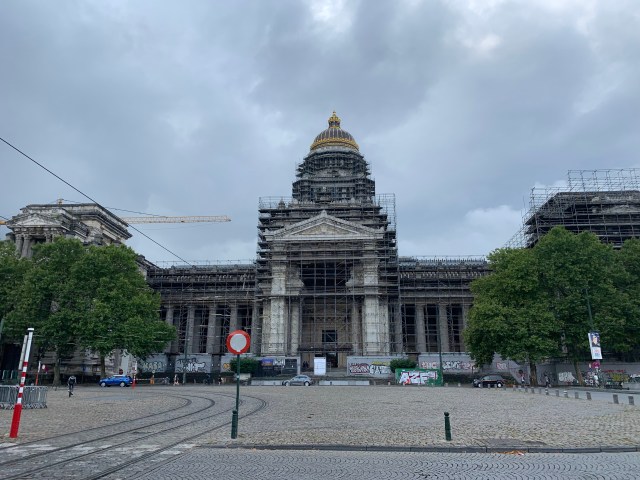
Alright so I didn’t actually get to go inside of Brussels main court, but I did get to observe. This massive structure sits atop one of the largest hills in Brussels so it is easy to see throughout the city. It is a building that truly encapsulates how the law of a land should be higher than anything else: higher than the royalty and government, higher than the people. Belgium does a wonderful job of displaying this.
Halle Gate
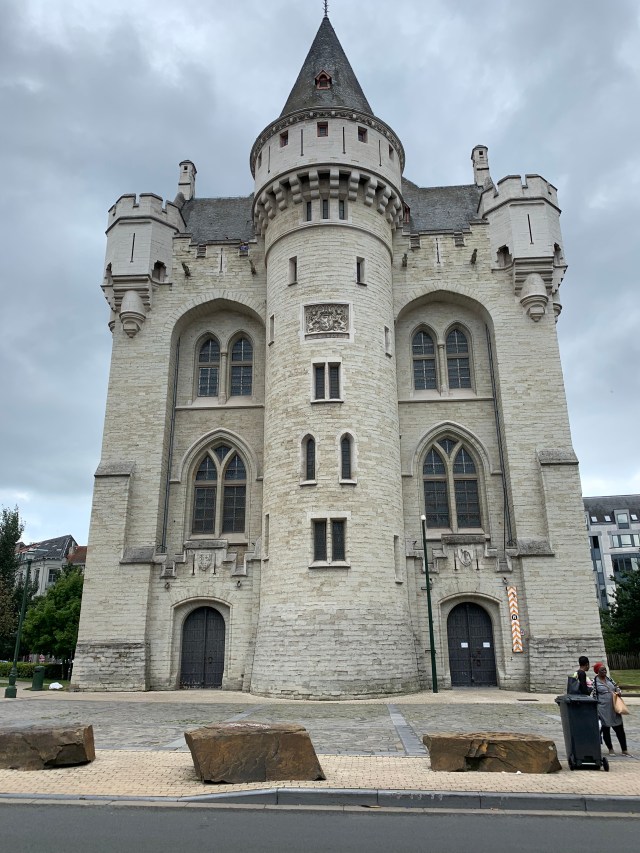
This fairy tale looking structure is actually a guard post for the wall that used to surround the city of Brussels. Inside this post is a museum outlining life in medieval Brussels. It show cases weapons, traditions, clothing, prisons, and so much more. In addition, at the top of the tower you can enjoy a 360 degree view of Brussels. Such a nice find, plus not many people are there to crowd the museum.
Mary Magdalene Chapel
Wondering through the streets in Europe chapels, churches, and cathedrals are common place. This chapel is just one of the thousands that are scatter throughout Europe and yet it holds onto its unique character. I implore anyone to simply go into a small chapel, sit down for half an hour and just watch. Marvel at the stain glass, smell the hundreds of years of history, find peace in the simplicity that surrounds you.
Mini-Europe
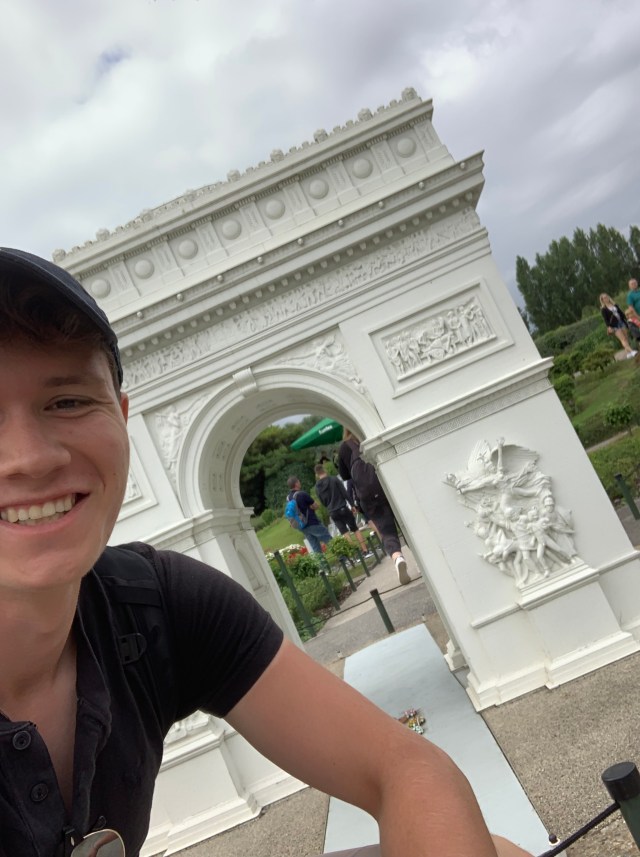
Who needs to bike through part of Europe over a few months when you can walk through all of Europe in about an hour?! Me 🙂 This fun little theme park is worth the visit. The attention to detail put into all of these structures is amazing and along with your walk you get a pamphlet telling you where everything is from and it’s significance to the country it is actually housed in. Furthermore, many of the structures have interactive elements, so if you want to see Mt. Vesuvius blow up you can see it here and not, well, not die.
Monument A la Gloire de I’Infanterie Belge
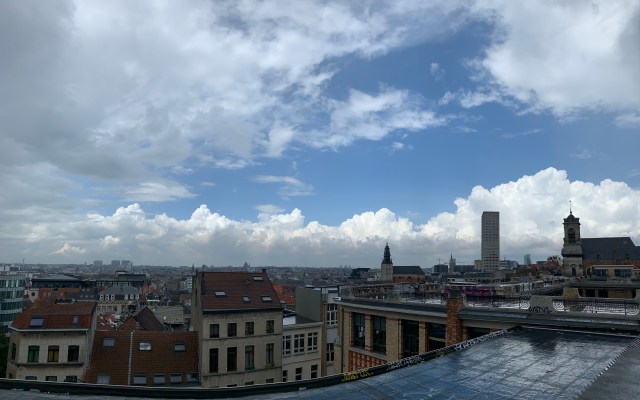
Right next to the Law Courts of Brussels lies a monument commemorating the Belgian infantry who fought in the World Wars. While this structure is wonderful and a true testament to those who sacrificed there lives for the betterment of our own most people do not visit this spot for the statue. Located right next to the memorial is one of the best views in the city. I spent a few nights here trying to catch the sunset.
Musical Instruments Museum
I was pleasantly surprised as I wondered through this museum. For anyone who knows me well, I am not a very musical person so as I made my way to this museum I had no idea what to expect. The MIM houses thousands of different instruments, but instead of describing what the instrument is and where is came from and it’s historical significance the audio guide plays a song featuring the given instrument. It was a pleasant surprise being able to walk through a music to a soundtrack that changes constantly.
Royal Museum of Fine Arts
Disclaimer, this one museum is actually six museums in one. It houses the Old Masters Museum (the 15th century to the 18th century), the Wiertz Museum (dedicated to Antoine Wiertz who was a controversial romantic artist in Belgium), the Meunier Museum (dedicated to Constantin Meunier), the Magritte Museum (dedicated to René Magritte), the Fin-de-Siécle Museum, and finally the Modern Museum. With over 20,000 pieces of art and sculptures this is an extremely impressive and moving museum.
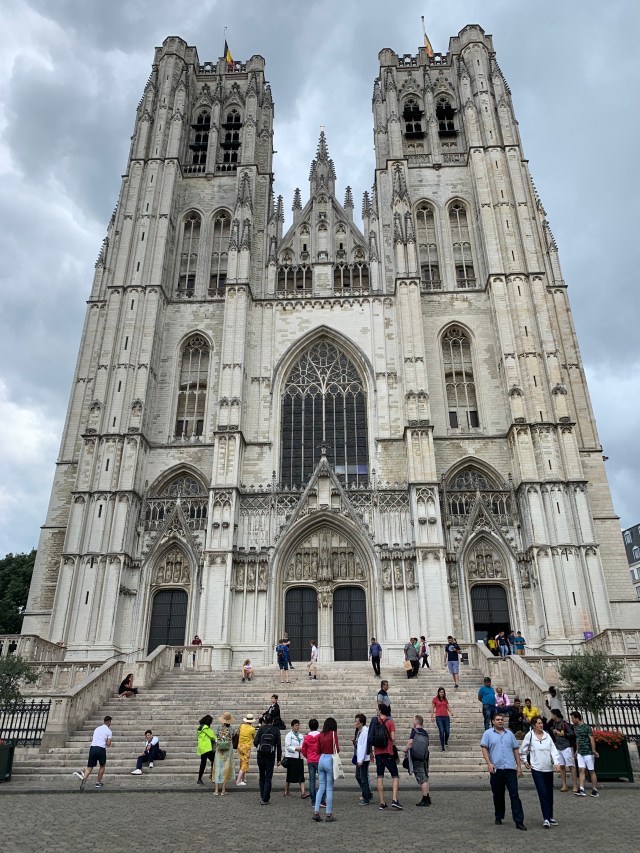
St. Michael and St. Gudula Cathedral
As Cathedrals go this is one of the more tame that I have been to. While it stands, emitting grandeur, in the middle of the city and is surrounded by the parks and restaurants, the inside is not boastful of it’s past nor is it informational in that regard. Walking into it is as if you were walking into your local church, getting ready to hear a sermon given by the local pastor.
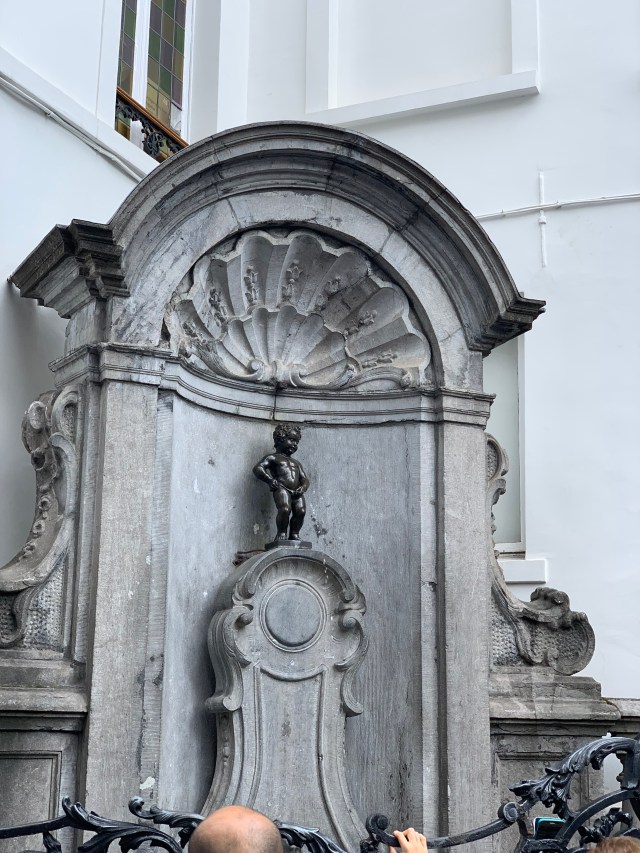
The Peeing Boy
This is one of the more amusing statues in Brussels. The famous peeing boy has been around, although it was replaced to the metal statue you see in the photo in the 20th century, for as long as anyone can remember. No one is quite sure of why it is there though many hypothesis that it was made to signify a certain part of the local market. The pee market. Before we could produce ammonia to make leather pee, which is high in ammonia, was sold at market and a statue like this would signify that.
Restaurants/Food:
WAFFLES!
I had sooo many waffles here. There are stands everywhere, but what you need to know is that there are two kinds that you can get. The traditional Belgian waffle is very fluffy, quite light, and completely delicious. My favorite though, the Leige waffle, is more dense, it has caramelized sugar on top, and it is impeccable with chocolate on the top.
FRIES!
When you are in Belgium you must have the fries. It is what they are known for and the fact that we call them FRENCH fries is beyond me
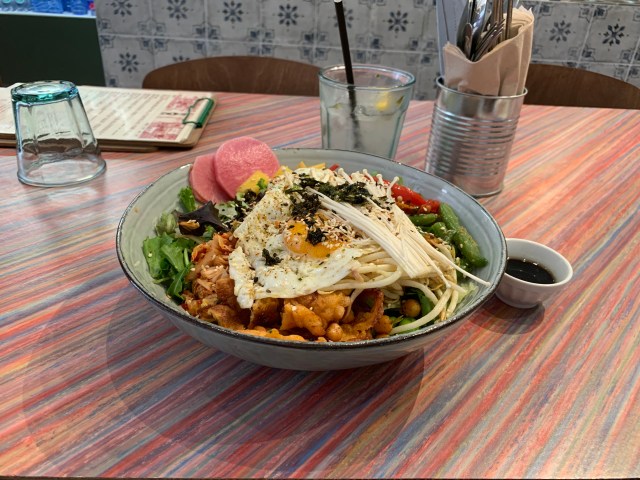
Yummy Bowl
When your in countries like Belgium, France, Germany, The Netherlands, all of the food is very rich, very fatty, and sometimes you just want a salad. The amount of times I have craved a salad has gone up exponentially since being in San Francisco. This place offers a really healthy, very delicious, salad and noodle bowl.
Bia Mara
Just because were in Belgium doesn’t mean we can’t still enjoy fried fish… there are a few constants in this world and one of them is that it’s very hard to mess up fish and chips. This place exceeds that standard and brings a modern twist to this classic dish.
Peck 47
Legitimately the best waffle I had in Brussels came from here. It was not a dessert nor was it breakfast, but a savory waffle. The ability of this place to mesh flavors from different cultures together makes it one of the best places I went to in Brussels.
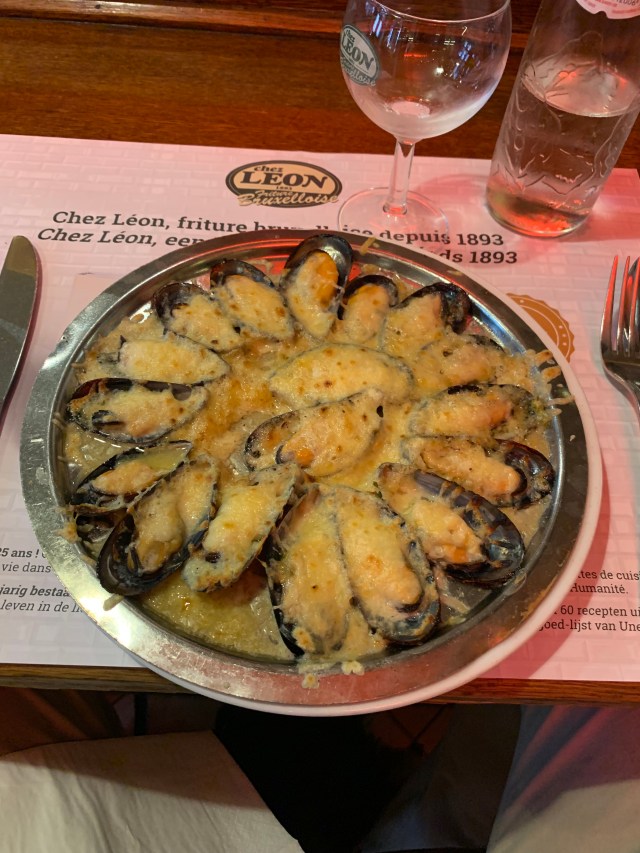
Le Chou
Look y’all if you want mussels in Brussels (fun to say right?) you need to stop by this place. They have it almost every way you could want it and one of the biggest most pleasant surprises came from this place. Mussels and cheese. It sounds weird I know, but it is delicious!
To be quite frank, I found Antwerp rather disappointing. Not to say that it wasn’t a wonderful city to visit nor to say I didn’t have good experiences there, it was just a very mediocre city for being the second largest city in Belgium. The main turn off of the city however, was a surprise. I entered into Antwerp’s main museum, Museum aan de Stroom, expecting to be blown away by the history and culture that Antwerp had promised. Instead I entered into one of the most disorganized and disinteresting museums I have ever been in. Exhibits failed to explain what they were presenting to the public and how it had any relevance to anything. Furthermore, as I perused around this informational hodgepodge and I started to think I may have found a connection between what was being presented in an exhibit it would flip to a completely different, unrelated, topic. For example, one exhibit started off with the parade of the giants in Belgium(actually pretty interesting if you would like to research it further) and then as I turned the corner they began explaining the time in which girls are considered to turn into women in many areas of South America. Those two topics don’t correlate and have no business being put next to each other.
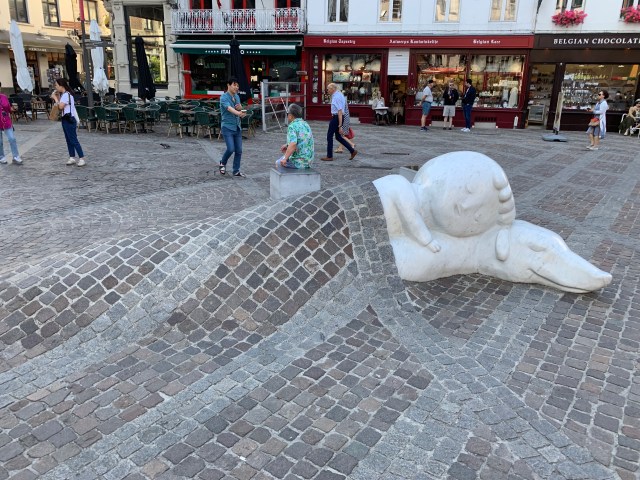
Now there were many saving graces during my time here. The city was able to capture it’s history in it’s cobblestone streets and old buildings that seemed to have more memories than I. Furthermore, art was a commonality in the streets. Walls were painted with cartoons and there was even a street that acted as a blanket for a puppy and child.
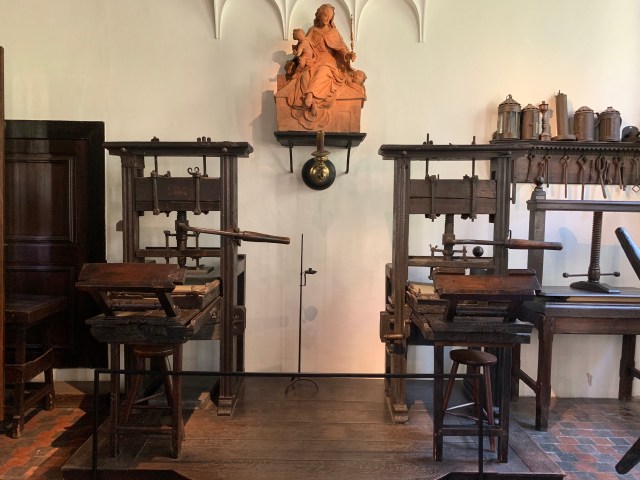
In addition, the printing museum was truly fascinating. This museum, which holds the two oldest printing presses in the world, is about the history of the printing press, it’s effect of society, and the Plantin-Moreaus family which was controlled the largest printing operation in the world during it’s peak.
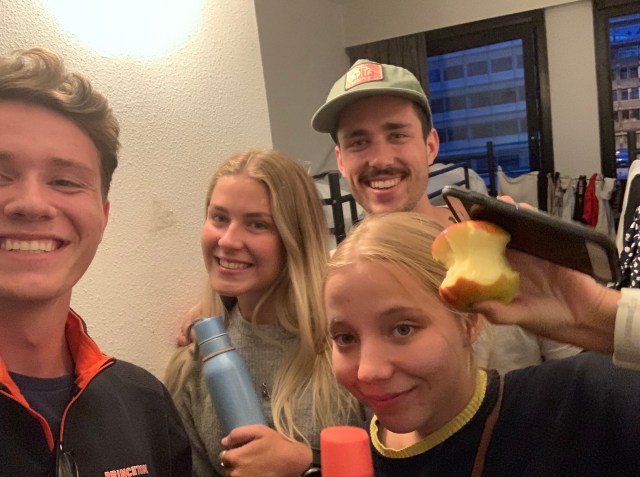
Finally and probably the biggest saving grace of Antwerp were my bunk mates. Hostels are tricky things. While none are exactly alike they all offer you the chance to meet extremely interesting people – for better or for worse. I have been lucky so far. In Amsterdam the two Germans I met were hilarious and wonderful to hang out with and in Antwerp the three Australians and one Canadian I met were equally as hilarious and even more fun to be around. Especially when traveling alone, it’s these interactions with people that have a lasting effect on me. I think it’s going to be the interactions and connections that I make with people, not things or places, that will escape my memory last.
As the bike paths turned to designated areas in roads and the flat plains began to have a distinct curve to them I knew my time in the Netherlands was coming to an end. No longer was my path guided by colorful rivers nor the crimson bike paths that I had been accustomed to. Instead a mixture of pastures and forests guided my way to Belgium’s second largest city.
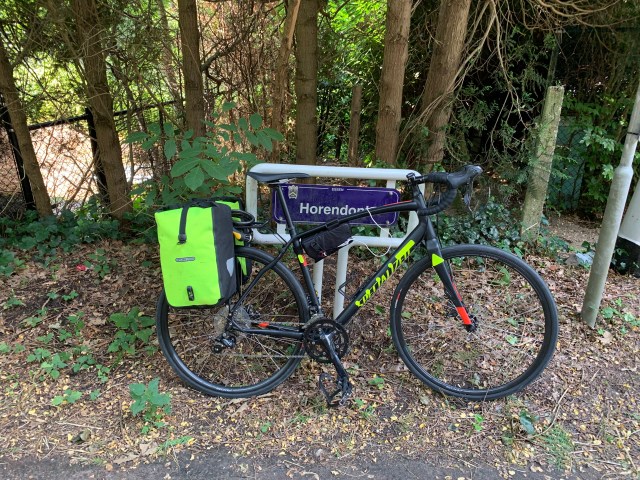
The front half of my bike is in the Netherlands while the back half is in Belgium
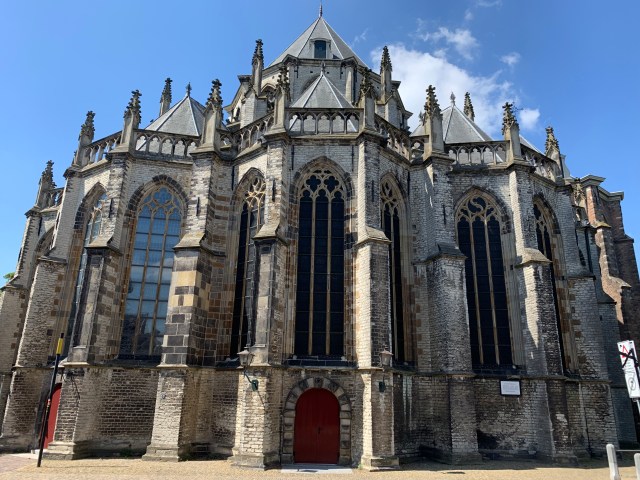
On my way however, I made a special stop in my fathers birth town: Dordrecht. It was hard not to attempt to picture this picturesque city over 50 years ago as a young grad student and his wife held the hands of a small child who would later become my father. A sense of familiarity and almost a nostalgic warmth wafted over me as I biked throughout Dordrecht, a town I had never seen before. As I visited the church in which my grandfather had preached, I couldn’t help to think that some of the elderly people who walked passed me may have known my grandparents and maybe even my father. It’s a long shot, but I’d like to think that many of them were their friends.
Now I could continue to describe to you in detail the beauty of the ride I went on. I’d most likely use metaphors and other literary devices to make it sound poetic, but I feel like I’ve been doing that a lot recently so instead I’m going to tell you about how, after more than 18 years on this earth, I finally learned how to bike. Now don’t get me wrong, I’ve “known” how to bike for a very long time. I grew up biking around and I’ve biked in Europe before, but never have I had to bike for four or five hours at a time. My style of biking previously was to just go as fast as I can: I raced against myself, against my brother, and even against google maps. I raced everywhere and every time somebody passed me I’d bike even harder. That doesn’t work for the distances I’m traveling. I began many of my trips peddling hard, glancing down at my eta every other minute to see if it had changed, and after about half an hour my legs would begin to stiffen. After about an hour fatigue would start to kick in and then everything started to devolve from there. It was especially bad in the Netherlands for you see, as I have said many times before, the Netherland’s are made for biking and everyone knows that. Professional bikers know that. So, many people who compete in biking races are biking the same paths I biked on and when one attempts to race with a professional biker who doesn’t have an extra 30lbs of luggage and who actually knows how to pace themselves things start to disintegrate, quickly.
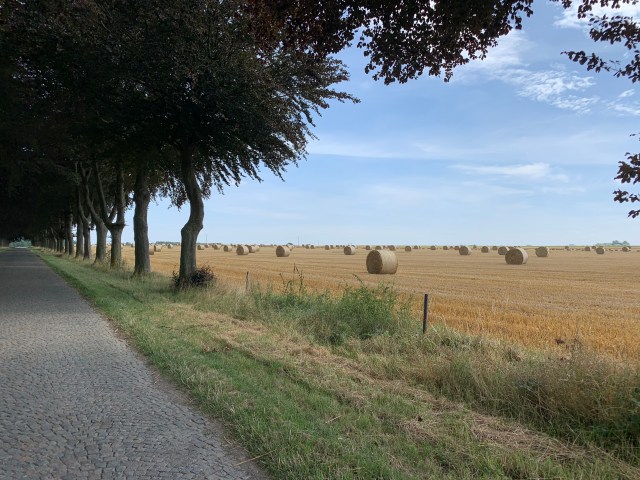
I almost got hit by a car taking this photo so y’all best enjoy it.
What I learned on my trip from Rotterdam to Antwerp is that biking is all about moderation. Pushing yourself is necessary, as it is in every aspect of live. Push to hard however, and you may just shove yourself into the ground. Sure you’ll move farther, but while you’re getting up the guy who’s being pushed is already past you. During my ride I decided not to race against the clock, not to compete against the professionals, and to simply push myself, wary of the junction of the trip I was at. I ended up cutting down my time by about half an hour. This is a perfect metaphor for life. When your in the long haul, whether it’s a relationship, a job, school, etc., don’t shove yourself, stay constant, and then when the time is right push harder. That’s how endurance is built.
The city of Rotterdam has been around since roughly 1270 after the building of a damn on the river Rotte. Home to the largest port in Europe this city quickly out grew it’s neighboring cities and became a dominant city in the Netherlands, second only to Amsterdam. Rotterdam was almost like the rebellious little brother to the more grown Amsterdam. The night life here flourished in the early 19th century with Rotterdam being a central city for jazz music and dance. Even during German occupation Jazz clubs thrived in secret clubs, avoiding the ban on night life. The Rotterdam I visited however, had no physical remnants of that 1270 city nor the early 19th century city left. On May 14, 1940 Nazi forces bombed Rotterdam to oblivion. A massive fire consumed what had not already been destroyed in the explosions and while the bombing raid only lasted ten minutes the effects were ever lasting. Historic landmarks, thousands of homes, and countless businesses were burned to the ground leaving this once thriving city a waste land.
The spirit of Rotterdam persevered however. After the war reconstruction began and the city designers had a unique vision for the new city. Modern architects were hired and in turn unconventional buildings were built. Walking through the streets of Rotterdam is almost like walking through an art gallery. Buildings and bridges of all shapes and sizes are erected throughout the city, displaying Rotterdam’s resilience. The jazz that once swept through the city has been replaced by Rotterdam’s deep connection with hip-hop music, dance, and style. I wandered into an art museum expecting to find large sculptures and intricate paintings, but no. The first exhibit was on the history of hip hop and an exhibit on the style. Even when I visited the Rotterdam museum one of there largest exhibits was based around hip hop and how influential it became in the city. Today Rotterdam bears the markings of a city on the rise. A city risen from the literally risen from the ashes is set to become an influential powerhouse in Europe.
Museums/landmarks:
Rotterdam Museum:
This small museum vividly outlines this beautiful city’s 749 year history. It includes interactive exhibits, like the hip-hop one which includes headphones playing Dutch hip-hop, and lots of little fun tid-bits about the towns history.
Kunsthal Rotterdam:
To be frank this museum seems like three museums in one. The first museum is a hip-hop museum. It outlines both the entire history of hip-hop: where it originated, the main influencers, fashion, etc. and the history of hip-hop in Rotterdam: how it came to the Netherlands, how it influenced the public, etc. The second museum consisted of large modern art instillation that focused on general social and political issues. The third museum held architectural designs for prisons as well as drawings of cities designed by someone who never brought these imaginations into realty. The fourth, is a myriad of photographs of white South Africans simply living. Each section of this museum has something new and unique to offer and I thoroughly enjoyed my time there. It all seemed very disconnected though.
Euromast tower:
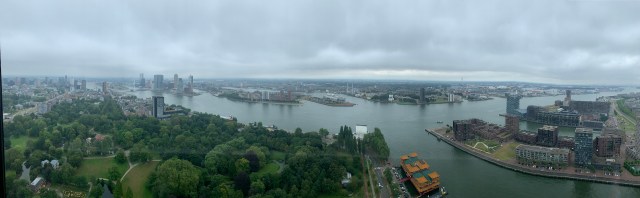
If you are ever in Rotterdam visiting the Euromast tower is a must. Not only do you get to enjoy a 360 degree view of the city from the cities highest point you also are informed about the history of the city. The views are incredible and the history is fascinating.
Cube houses:
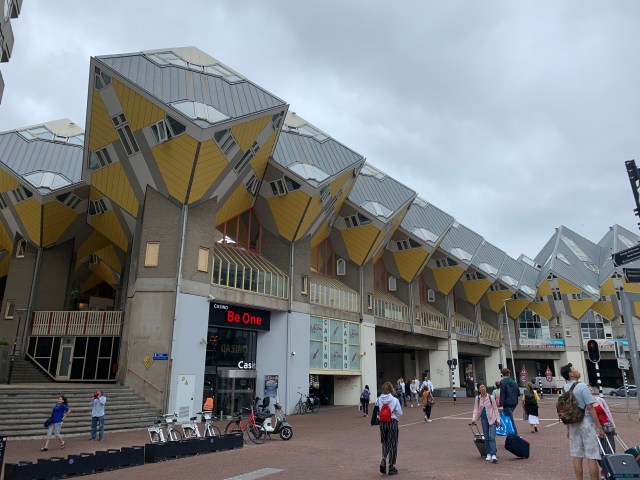
The Cube houses are probably the oddest set of buildings I have ever seen or stayed in. Constructed after the Second World War, these buildings not only are home to apartments, hostels (I stayed here :)), and local businesses they also act as a bridge, covering a major roadway. The unique quality of this building makes it a wonderful place to visit during your stay in Rotterdam.
Marthal eats:
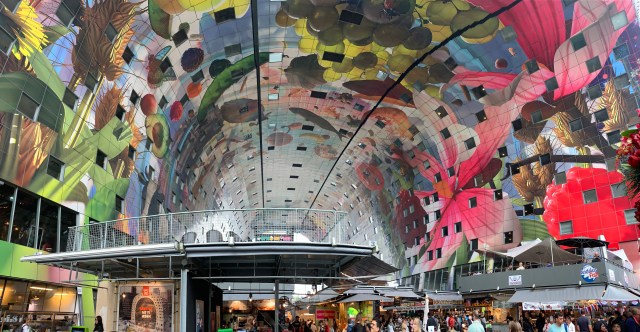
Yet another unique structure in Rotterdam! This tunnel esc building houses a market with restaurants of all kinds and the panels you see in the photo below are the windows of the apartments that are on the outside of the building. SO COOL!
I’ve said it once and I will say it again, the Netherland’s are made for biking. This 73 kilometer ride was as if I transcended the seasons and went from summer into fall in a matter of hours. I started in the summer. Upwards of 90 degrees and not a cloud in the sky to protect me from the overbearing sun nor to hide the beauty of the land I was riding on. Oceans of emerald green fields are strewn across this nation’s sprawling countryside. Each one harboring crops and cattle, each one producing the food which feeds a country. Intersecting these colossus fields were the Netherland’s rivers. Moss joined the deep blues of the the rivers clothing them with additional reds and greens while yellow and orange boats sailed across. It was as if a rainbow had decided it was sick of the sky and instead wanted to flow through nature in these streams.
The first sign of fall was the wind. Once a gentle breeze this invisible force began to roar, drowning out the delicate chirps of chickens and the serene sound of water hitting rock that used to fill the air. The oceanic fields were replaced with mountainous windmills and swarms of skyscraper esc trees, while the purely azure sky became a grey landmass. Even the river’s colorful qualities dulled due to the lack of light. Water became even more of a necessity because whenever I opened my mouth the wind would dry it out in an instant. And finally, the sun’s stringent rays melted into a gentle drizzle. Before this ride I would have to wait until I reached the comfort of my hostel to feel the relief of water cooling my back and the joy of AC slowing my pulsing heart, nature gave it to me an hour before then.
Each season I rode into had something to share and something to take away. Nothing is absolute, especially not nature. When looking at any aspect of life we must address the contrasting qualities it possesses. The sun, while incredulously hot and blinding, provides light and color into the world. The wind, while loud and abusive, provides a coolness to a world once consumed in heat. Everything in this world is whole and round. Things only become two-dimensional when we limit ourselves to the idea that they should be.
Amsterdam, also known as the Venice of the North, is an incredible city. First settled in 1000 this city’s 1,019 year history has been full of lots of ups and lots of downs. Amsterdam was traditionally a trading town. With the Amstel river (the river helped name the town) running through Amsterdam and into the ocean, this small city became a main trading port on the world stage during 17th century. During this time the Dutch had a golden age in which wealth and prosperity flowed through the city as well as art and technology. Only when there ability to trade was cut off due to a French invasion did Amsterdam’s economy fall, but with the fall of their economy came the rise of their democracy and a future full of freedom. Amsterdam has a long history of freedom: they promoted religious tolerance in the 17th and 18th centuries when no one else would, during World War I they became known as northern Jerusalem due to the amount of Jewish refugees they took in, during World War II they were the only city in Europe to hold a united protest against the Nazi’s, and in 2001 the first gay coupled was married in this very town. Amsterdam today is only about half Dutch. That is nearly 50% of Amsterdam’s residence are apart of the 176 different nationalities living in Amsterdam, making it one of the most diverse countries in the world.
Putting aside Europe’s record breaking heat wave (thanks global warming) my time here has been unbelievable. The people are some of the kindest and most open you will ever meet. I cannot tell you how many wonderful conversations I’ve had with complete strangers – each one more interesting and insightful than the last. A lot of these conversations were possible due to Amsterdam’s predominantly bilingual population. There were times in which I thought I was speaking to an American when in reality they had lived in Amsterdam their entire life. While still on the subject of people, I feel I should quickly apologize to my roommates who slept in my hostel room. I am a morning person, so waking up at 7am is commonplace for me but, not so much for my roommates who had to deal with my getting ready while they tried to sleep in until late morning. In addition to the people, the history ingrained into these cities streets is fascinating. There were times when I would simply wander the city and run into amazing art galleries, historic statues, or unparalleled sights. If you ever travel abroad and have the time and or energy to simply wander a city with no plan, no idea of what you are going to find, please try it out. Some of the best experiences and some of the best finds are behind that door we’ve never opened.
All of my three days here have been filled with amazing food, wonderful sights, fascinating facts, interesting people, and so many more indescribable events. Below you’ll find a few of the places I visited in my time here and my reaction to them.
Museums: There are sooo many museums in Amsterdam!!! It’s so great 🙂 If you can’t tell… I love museums.
Allard Pierson
I want to preface this with I went to this museum while it was under construction so take this with a grain of salt because I am almost certain it will be different in about a year. The Allard Pierson museum is connected to Amsterdam University College and mainly focuses on Greek, Roman, Egyptian, and Mesopotamian history. It was an odd experience for me, not because of the artifacts nor the history, but because I was completely alone. There was not another soul in that museum which made it strange walking around and reading about the artifacts. In regards to the actual content of the museum I thought it was extremely interesting and gave lots of incites into those specific cultures – though it is not exactly unique to Amsterdam.
Amsterdam Museum
If you are searching for a historical museum to visit this is the one you want to go to. The Amsterdam museum goes into depth about the entire lifespan of Amsterdam (1000-present). First settled in 1000, after a flood that created the means for a port, Amsterdam has ebbed and followed being one of the greatest and most influential cities in the world to being broken to where it is now which is a pretty happy medium. The free audio tour, informative videos, and the detailed descriptions of events that occurred within this city truly makes this one of the most informative, if not one of the best museums in Amsterdam.
Anne Frank House
The main thing to know about this museum is that it is the most popular museum in Amsterdam so you need to buy tickets close to two months in advance or else you will be like me: refreshing your web browser to get on the ticket line for the day of tickets. Unlike me, even if you do get stuck trying to get tickets day of, you will get those tickets and not get stuck at 7th in line when they run out of tickets.
Cheese Museum
Alright, this is not a museum. I do not care who says otherwise. This is a marketing ploy by a very smart cheese company. Not worth any time… unless you want cheese from the store on the main level.
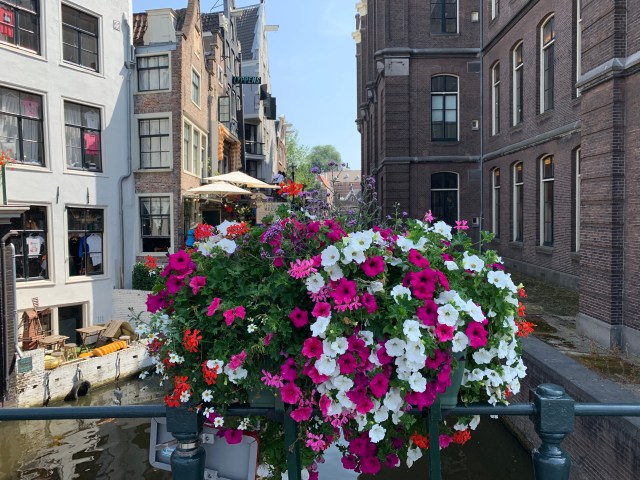
Have some pretty flowers to make up for the disappointment of the cheese museum
FOAM
This is probably the strangest museum I have ever visited. The first exhibit I entered into is an attempt to replicate the feeling of a psychedelic drug that is commonly used in South American rituals. As I continued on… side note here it will look as if the bottom exhibit is the end but, there are a set of stairs that will take you to the upper levels… I entered into a photography exhibit which displayed provoking photographs of women in the mid 90’s as well as short films about the photos. The third and final exhibit was one that used a three dimensional medium combined with an electronic medium to provide a consuming piece of artwork. If I’m being honest this place was not my cup of tea but, if you like pushing the limits when it comes to art check it out.
Moco Museum
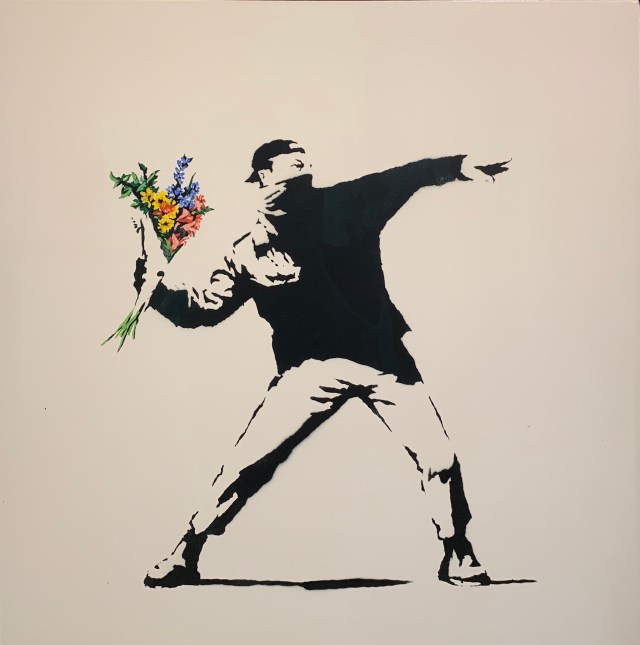
I really enjoyed my visit to this museum. Set in a house, instead of a traditional museum layout, this museum is mainly filled with street artists and artists who choose to diverge from the norm in regard to art. The Moco features a lot of work by Banksy, an American street artist, and other artists who share his views of anti establishment and anti capitalism. Would highly recommend.
Munttoren
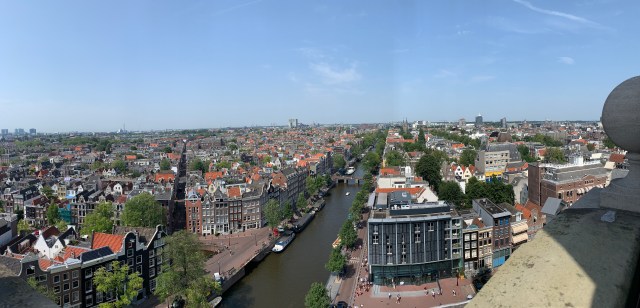
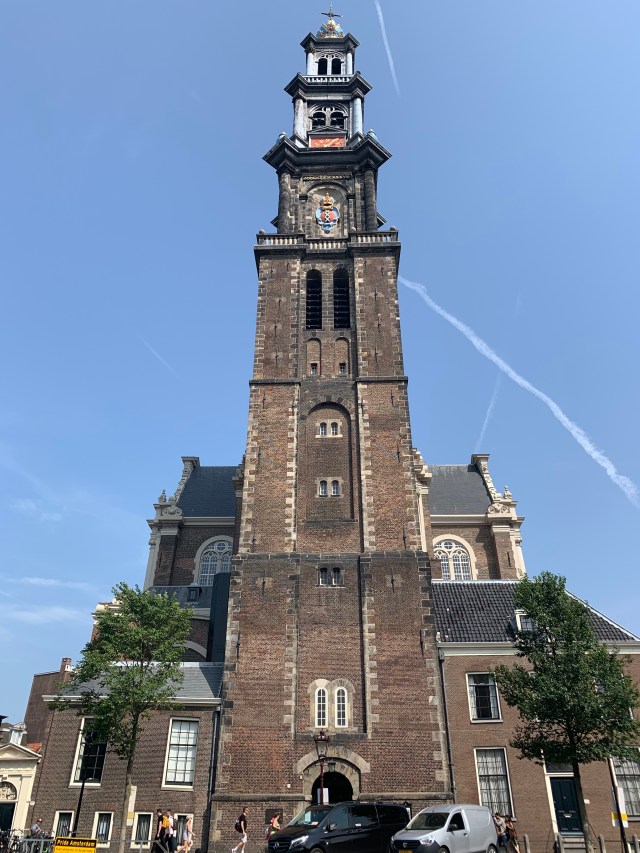
An amazing find! Located close to the Anne Frank museum this bell tower is composed of original materials and provides a stunning 360 degree view of the city. The tower, which is also a church, was the first originally Protestant church in Amsterdam (Catholic Churches we’re forced to convert)and the bells that are within the church still ring today to mark the hours. Fun fact about the bells: the secret about how to tune bells was lost for 150 years after the original maker died.
New Church
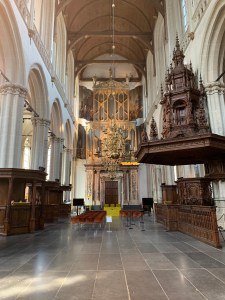
This church is the physical manifestation of Amsterdam’s history. Constructed amidst the Dutch Golden Age this church has been a place of worship (for both Catholics and Protestants), a communal building, a concert hall, and even a trading post. It is located right next to the palace (previously the town hall) to show the secular and religious unity of Amsterdam. Inside the church you’ll find the tombstones of famous generals, an incredible organ, and educational videos outlining the church’s and in turn the city’s history.
Royal Palace
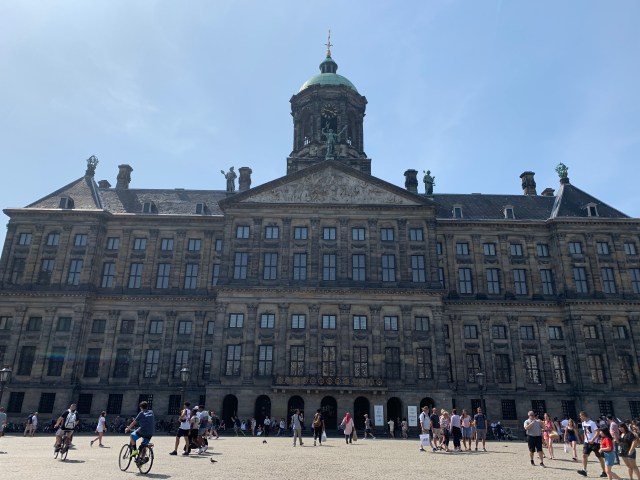
Unlike places like London or Paris, Amsterdam is not filled with structures of grandeur, this palace is the one exception. This palace was originally a town hall, but when France invaded and took over Amsterdam it was converted into a palace fit for the King Napoleon. It houses lavish rooms, which can be further explained on the complementary audio tours, maps etched into the floors, ranging from the world to the heavens, and dozens of documents, mainly educational, that were housed in its operation. It is a good museum, but when given the choice between this and the Amsterdam museum I would choose the latter due to the better content it houses.
Rijksmuseum
The Rijksmuseum is a wonderful museum filled with art, relics, and centuries of history. see my post about it for more info on it.
Stedelijk Museum
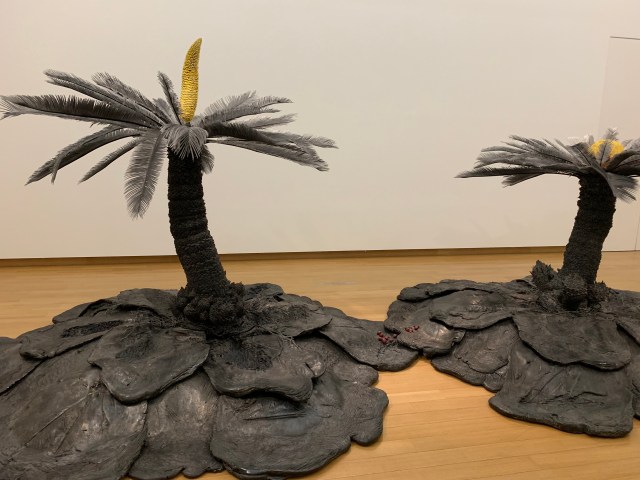
An impressive museum that exposes the public to modern and post-modern artists such as De Jong, Thomas Hirschhorn, Theo Wolvecamp, and so many more. The wonderful thing about this museum is the amount of mediums you will be able to view. From crafted molten lava to aged potatoes these artists encapsulate what it means to be an innovative artist in this day and age.
Van Gogh Museum
This museum is a brilliant showcase of the famous, one eared, Van Gogh. Not only does it exhibit Van Gogh’s art it displays art that inspired Van Gogh, his letters (which you can listen to in your preferred language), the science behind his art, and even attempts to recreate dream sequences. It is hard not to be inspired walking through this museum. Van Gogh’s history, his passion for art, and his devotion to that passion in spite of the hurdles put in his way is something to strive for.
Restaurant/Food recommendations: We all need to eat, might as well eat stuff that tastes good.
Moeder’s
This local favorite does not disappoint in any regard. The food here is impeccable: whatever you order make sure to get the baked potatoes because they are some of the best potatoes I have ever had. Furthermore the entire atmosphere of this place is something you’ll never forget. All of the walls are covered in pictures of mothers (moeder in Dutch)and families making the entire vibe of the restaurant homey and genuine.
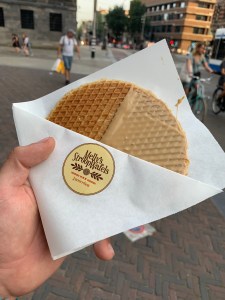
Melly’s StroopWaffels
Stroopwaffels are one of the staples of Amsterdam’s cuisine and they are sold all over the place. This place however, makes them fresh to order and they are flippin’ amazing!
Back to Black cafe
I cannot recommend this place MORE. It may have changed my opinion on tea, which as most of you know is contrary to the norm, and it definitely heightened my love of apple cakes. It’s cozy, friendly, and most importantly serves impeccable food.
Bhatti Pasal
I know, I know I’m in Amsterdam. I should stick to eating Danish food but, screw that because this city is insanely diverse. It’d be like going to New York and only eating bagels. If you ever venture over here please check out this little hole in the wall. It has amazing, authentic, Nepalese food.
*little tip about this place: If you get the Momos also get a side of the crispy rice. It adds a wonderful texture element to the dish and can act as a bread substitute when soaking up the excess sauce.
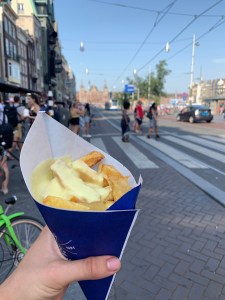
Fries!
There are stands that sell bags of fries with your choice of sauce. I had the Amsterdam onion sauce and it was delicious.
Pancakes!
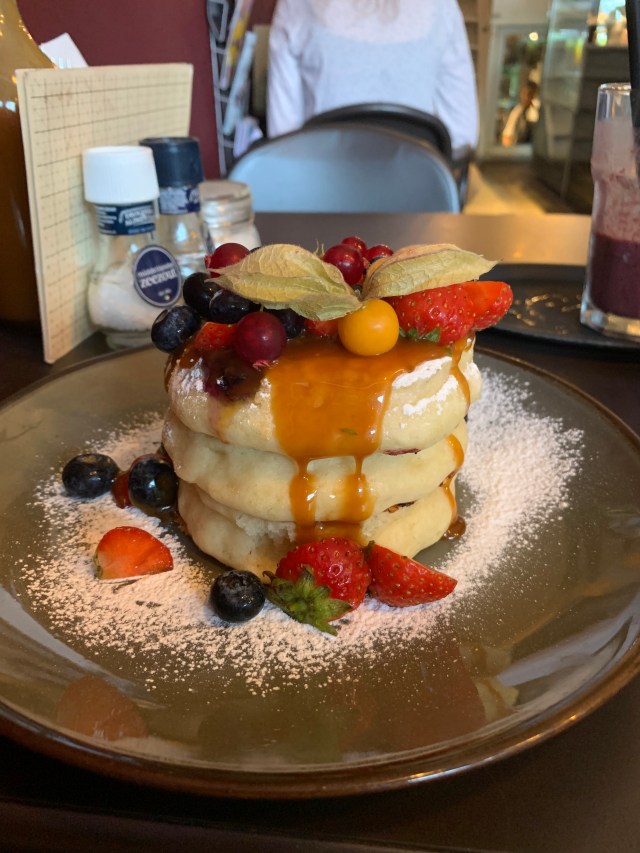
Another staple of Amsterdam is their pancakes. Like the fries and stroopwaffels you can find these all over town and most places will do an impeccable job. The pancakes are reminiscent of thicker, richer, crepes.
Best spots to visit: This city is bloody beautiful!
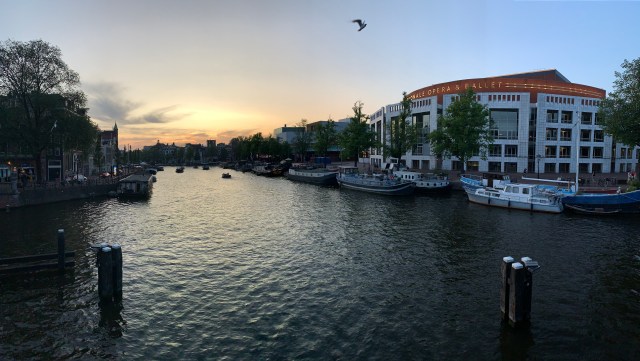
Blauwbrug Bridge
An Amazing place to watch the sunset 🙂
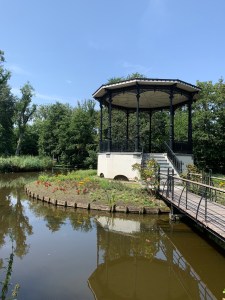
Vondelpark
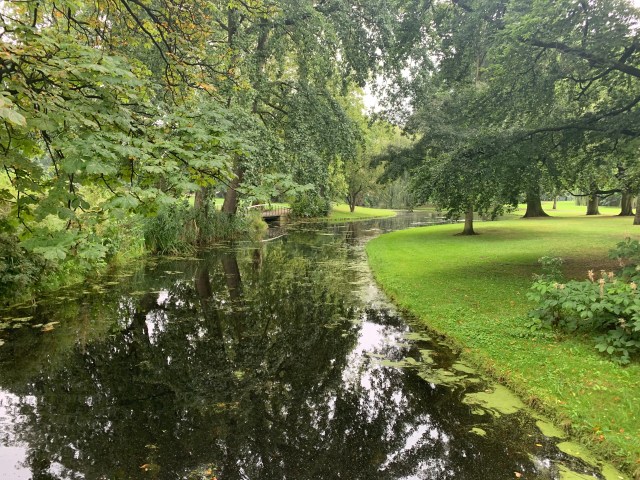
This care free, beautiful, park is one of many scattered throughout Amsterdam. This is set apart from the rest however, due to it’s scenic structures and small ponds shaded by trees.
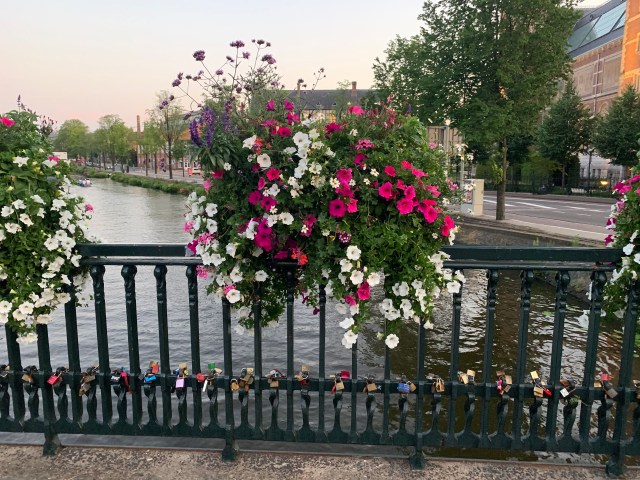
Love Lock Bridges
Throughout Amsterdam there are bridges covered in padlocks signifying the eternal love that couples have for each other. I happened to stumble across one of the smaller ones.
De Dam Square
The square right in front of the new church and the Royal Palace is home to street shows, food vendors, and lots and lots of pigeons. Every time I walked through I saw something cool or something I didn’t expect.
The Rijksmuseum is the heart and soul of the classical art scene in Amsterdam. First opened in 1800 this museum houses paintings, sculptures, ceramics, jewelry and many more relics. During my time here the museum had a Rembrandt exhibition, which included Rembrandt’s famous Night Watch, that emphasized the quality of art shown within these museums walls. Below I’ve attached a few of my favorites – I tried to stay away from the more famous ones and show you the less known ones that caught my eye but, some of the famous ones will be included as well.
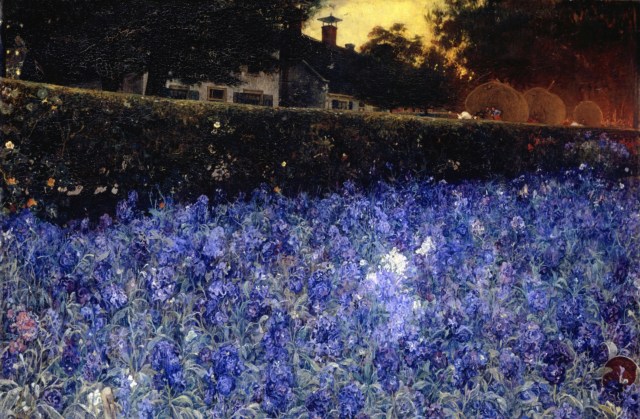
July by Jacobus van Looy
Jacobus van Looy was a Dutch painter who found success during the Netherlands’ Golden Age. Looy is most famous for his portraits but, for this specific painting Van Gough’s depiction of landscapes inspired him to do his own, more realistic version, of a post-impressionist landscape. The painting is of a sea of blue flowers encroaching into the shadows. In the background Looy’s house and the rising sun can be observed.
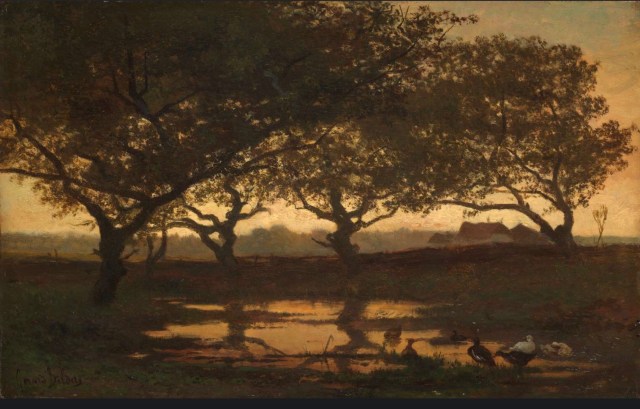
Woodland Pond at Sunset By Johan Hendrik Weissenbruch
Johan Hendrik Weissenbruchwas a Dutch artist who, like so many others on this list, made a name for himself during the Netherlands’ Golden Age. Being born into an artistic family Weissenbruch was destined to be an artist. He began painting at the age of 16, mainly painting detailed cityscapes. As he grew he became infatuated with the colors of nature, Woodland Pond at Sunset is his attempt to highlight the beauty of Dutch sunsets.
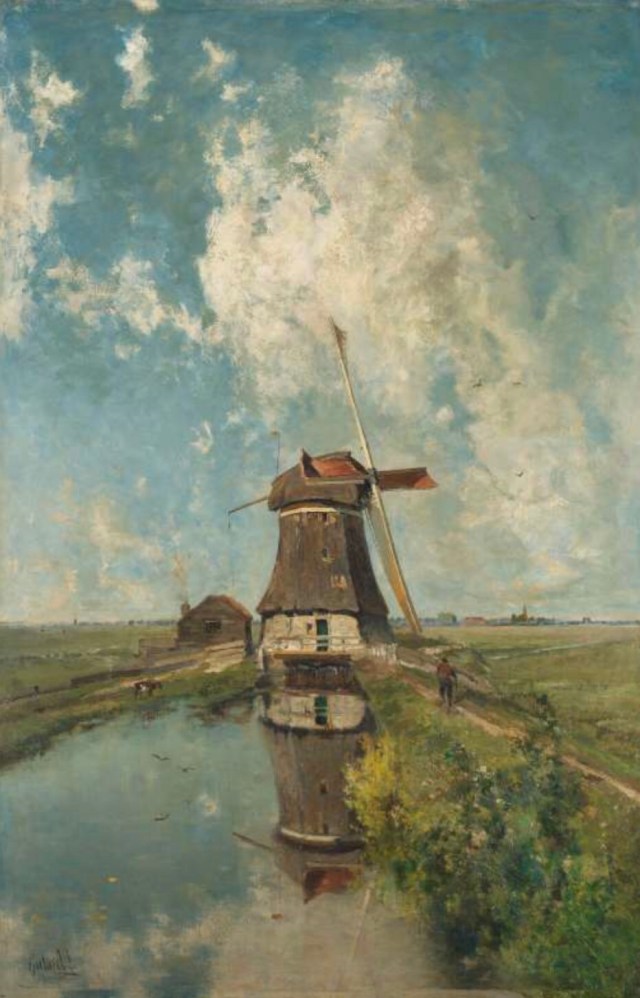
A Windmill on a Polder Waterway by Paul Joseph Constantin Gabriël
Unlike many other painters Paul Joseph Constantin Gabriëlwas forced into art at an early age. A natural proficient in art his large family turned to him for income when his father died. Gabriël, who grew up in Amsterdam, became an apprentice to Koekkoek who steered him in the direction of landscapes. I was drawn to this painting not for the center point but rather the clouds that surround it. The clouds, in my opinion, are a true representation of the beauty of chaos.
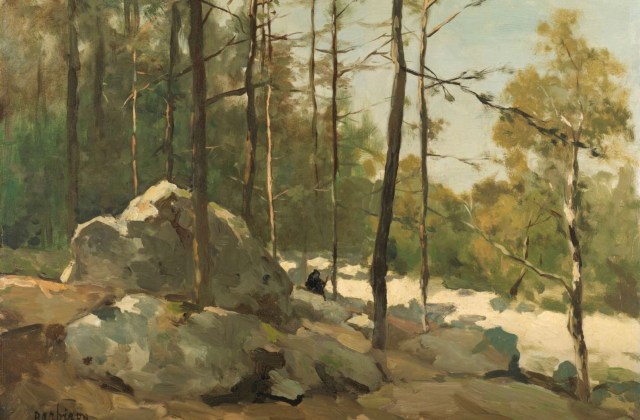
Wooded view near Babizon by Johan Hendrik Weissenbruch
Here we have another one of Weussenbruch’s paintings. Painted on the outskirts of a small Dutch town this effectively self portrait of Weissenbruch points out how infinitesimally small humankind is in comparison to nature. However, the reason this painting grabbed my attention is due to the stark contrast of nature and man. The ambiguous man in this landscape is completely black, as if consumed by a shadow, which pops out at the viewer when put in a scene of lighter more dulled colors.
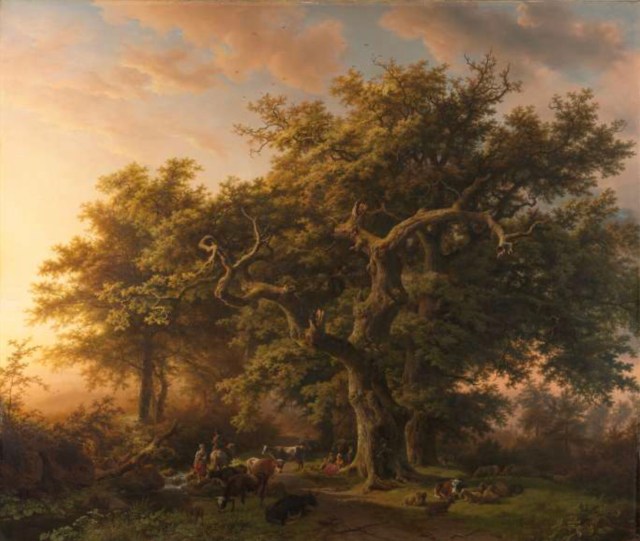
Forest Scene by Barend Cornelis Koekkoek
Born in a small province in the Netherlands Koekkoek began his study of art under his father. He then enrolled into the Middelburg Academy and then the Academy of Amsterdam after he had already travelled through the Alps painting. Koekkoek’s success has become synonymous with that of the Dutch Romantic movement as he tended to portray his pieces in a more beautiful and idealistic way. This is most aptly shown in Koekkoek’s Forest Scene.
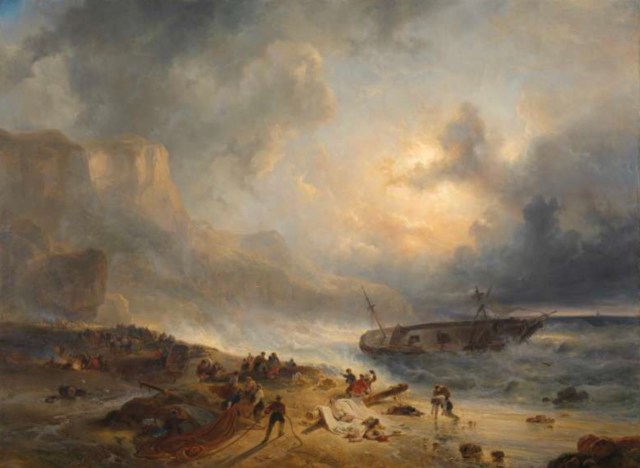
Shipwreck off a Rocky coast by Wijnand Nuijen
Wijnand Nuijen was a Dutch artist inspired by the Romantic artists of France. In his late teens Nuijen travelled to France to paint villages and the coast and in his time there he was inspired by artists such as Richard Parkes Bonington. In Shipwreck off a Rocky coast Nuijen is showing, like so many artists on this list, this insignificance of mankind in comparison to nature. While the scene being expressed is one of turmoil the background composes most of the art. Furthermore, the sun, shining onto the shipwrecked survivors, becomes the focal point of the piece demanding the viewers attention.
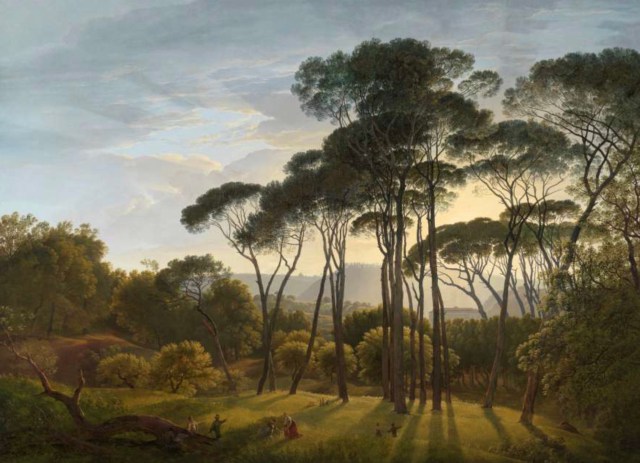
Italian Landscape with Umbrella Pines by Hendrik Voogd
Hendrik Voogd, also known as the Dutch Claude (Claude Loraine was a famous French painter), was a Dutch painter who spent nearly his entire life in Rome. This specific painting is intriguing simply due to the precision and subtle additions that the painter added to draw ones attention. Thousands of leaves are displayed in this painting and yet, the markers of a paint stroke are hard to find. Furthermore, when looking at the people in this painting the majority of them are pointing towards the setting sun which Voogd intended to be the focus of the painting.
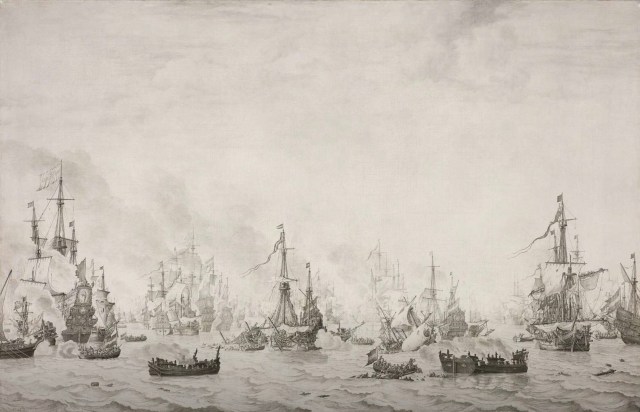
Battle of the Downs by William Van de Velde
William Van de Veldewas born to a fisherman in Leiden, Netherlands. Many hypothesize that he was actually born at sea given his aptitude for sailing and painting the ocean. The Battle of the Downs, as referenced above, was a battle between the English Navy and the Spanish Armada fought in the English Channel. The English victory marked a turning point in history which had the English commanding the seas opposed to the Spanish.
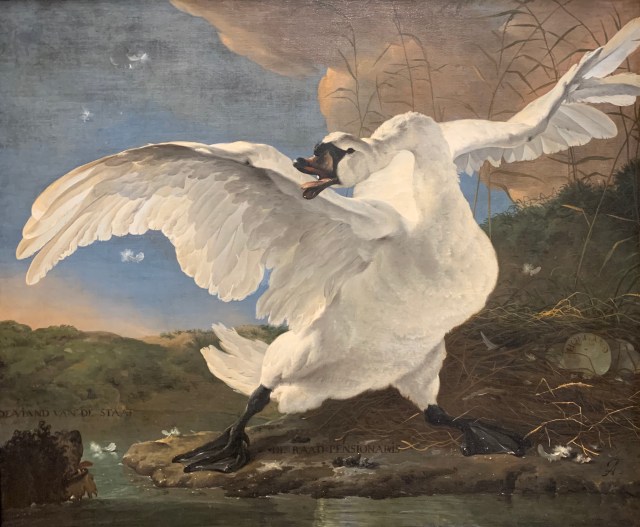
The Threatened Swan by Jan Asselijn
Jan Assellijn while having Dutch heritage was born in France and only moved back to his motherland when he married. The Threatened Swan is widely regarded as his best piece of artwork. The image shows a swan, which when shown in real life is life sized, protecting her eggs from a dog(shown in the bottom left corner). This painting, even though he never intended it to be, became a symbol of Dutch national resistance. Late on, under different ownership, people inscribed “Holland” on one of the eggs and “enemy of the state” next to the dog.
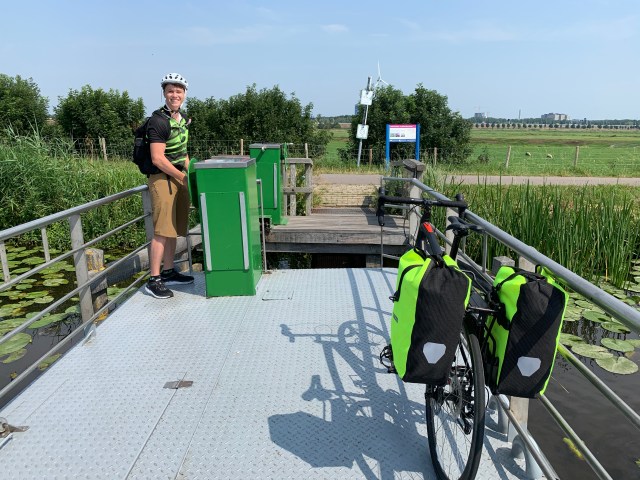
Holland was built for bikers. Not only has this been the most beautiful ride I have embarked on, it was the easiest. Not in sense of difficulty but due to the fact that for 95% of my 100km ride I was in a bike lane. Compared to my ride to Harwich which contained sixteen-wheelers going 60 miles an hour this protection was a blessing. Furthermore, the diversity of stunning sights was amazing. I began my trip on the coast of Holland. As I biked off the ferry I was immediately greeted by off white beaches, contrasting with the light blue ocean filled with almost noble sailing ships.
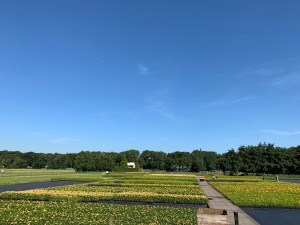
As I turned inland beaches and oceans transformed into green houses and forests. Green houses are far as the eye can see incited a sense of wonder within me. You would be hard pressed to find a place which utilizes this technology more than Holland. The forests, on the other hand, are derived from the very antithesis of technology. Biking surrounded by an armada of trees, older than most buildings to date, carries along with it a sense of intrigue and mystery hard to come by anywhere else. My trip inland did not fail to maintain it’s diverse trajectory. The farther in I went I was greeted by pastures filled with sheep, cows, and horses, farms containing a plethora of vibrant flowers, sugar beets, and grand wind mills and river after river with overjoyed families boating at high speeds and tall, intimidating, grasses growing into the background. It was as if I had been thrown into a utopia of sorts.
A utopia that was interrupted by 200km of bumps, hills, twists and turns. This was my second day in a row biking with only a six hour rest stop on a moving boat and to be frank my butt and back were more than aware of this. Every new crack in the road and every time I bent over to reach my lower, more aerodynamic, handles a new world of hurt would remind me that I really should have trained more for a trip of this magnitude. I recall seeing a horse flop down and enjoy, lazily, chewing on his mid-day snack and I couldn’t help but wishing I was that horse. Lying down, enjoying the cool grass as the scalding sun beat down on a biker only a few meters away. A dream which quickly faded after seeing the multitude of geographical wonders that followed. You see that horse is contained to her pasture, contained to the limited space allowed to her by another party. She will never be able to bask in the glory of the forests near by nor will she be able to see the endless ocean because, unlike you and me, she isn’t free. Freedom, for better or for worse, is the ability to roam, unhindered by a third parties will. Now none of us are really free, as we have to abide by the laws of a society, but there are certainly levels of freedom. The question is how do we utilize the limited freedom we possess? I implore you, don’t lie down and eat the grass instead jump over the fence, who knows what’ll be waiting for you?
My view while writing this
Cool stuff about the Netherlands!
The Netherlands are extremely flat and more than a quarter of it’s land is below sea level with 50% being just a meter above. This extremely wet landmass is very susceptible to floods. Usually this would not be a good thing but, the Danish have used this unique attribute to further their causes more than once. Starting with the Eighty years war against Spain (1584-1586) the Danes flooded strategic points to force Spanish armies out of the Netherlands. This natural weapon was used again in 1672 and the 18th century against French invasions. In addition, during World War II floods were used by both the Allies and the Nazi’s to push one another out of the region.
The Dutch’s knowledge of how to effectively flood a nation was not limited to the weaponization of water however. In a humanitarian effort, after hurricane Katrina, Dutch experts were called in to aid with the revitalization of Louisiana and other affected areas.
The original plan for this post was a quick synopsis of what I saw on my scenic ride from Cambridge to Harwich International Port. However, life doesn’t work that way. I began my 110km trek at 4:30 in the morning, now if you recall from my previous post about Cambridge first light is around 4am so it was plenty bright to start this journey. The main reason I started it at this unusual hour though is so I would be able to see the sun rising over the endless hay fields that Britain is home to. This aspect of the trip went perfectly: the sunset was stunning.
As I continued I was honestly surprised about how beautiful and at times humorous (In a morbid manner) England is. The canvas of England is painted with rich golds, vibrant greens, and ominous clouds. Riding through the country side you are surrounded by massive fields of golden hay and mini forests reminiscent of a time before the agricultural revolution. Streams are plentiful, hills are scarce, and livestock graze lazily, while the tumultuous wind blows when you least expect it (love the wind). With all of England’s beauty there is a darkness, almost humorous to be honest, that comes along with the country side. Signs that say “Drive safely, multiple casualties on this road” scatter the main roads. As a biker this is terrifying but, when looking at it in hindsight it’s quite hilariousl. Who in the world puts a sign like that up?!
The ride went swimmingly for the first two hours and then everything seemed to collapse. The first and least problematic event to happen was my light falling off. It’s almost poetic that the smallest part of my biking arsenal falls apart before the one of the most integral. I was able to recover my light and as a continued on the only thing hindering my progress was fatigue. While I can push through fatigue what I can’t push through is a broken rear rack (the thing that holds my luggage). About 5 miles outside of Sudbury my back wheel stopped moving and I thought that’s alright it’s probably a break malfunction or a flat tire, both of which I could fix, but no, the bolts of my rack had snapped off making it impossible to bike due to the luggage I still had (trust me I tried). So what laid before me was a 5 mile, hour and a half, walk to Sudbury’s local bike store. In the moment these unfortunate series of events seemed like a message from God: You are not prepared, what have you gotten yourself into?! But then something insane happened, stranger after stranger pulled over to make sure I was ok. Stranger after stranger offered their assistance. That accident exposed me to the purest form of hospitality: basic human kindness. Now to be fair most of the people who stopped were older women who were most likely reminded of their son or daughter when they saw me but, the hospitality didn’t stop there. In my stops at both Sudbury and Colchester I had the pleasure of interacting with the most friendly and welcoming wait staff I have ever encountered. It was as if I was at home, talking with an old friend, when in reality I am no where even close to my family nor my friends.
These set of events are really what this whole trip is about. I expected things to go wrong, I wanted things to go wrong, because things that seem like a curse at the time have the potential to become a great adventure.
Fun fact about Sudbury:
The flag that was put up at Fort Henry during the War of 1812 with Britain started it’s life in Sudbury. This usually wouldn’t be a big deal except for the fact that the National Anthem derives from this battle. The United States was able to hold off the British and in the morning our flag was still flying, the flag that began it’s life in Sudbury England.
P.S. If you ever find yourself in this small town check out the Prado Lounge. Good food and impeccable service.
Biking Tips:
I guess this should be obvious but, make sure to check the maximum weight that your bike’s carriage can carry.
When biking on a high speed road be aware that when a truck or some other large vehicle passes you, you will feel a massive gust of wind that may be startling at times.
 Josh’s Bike Trip